
Baron Technology ETF | Q4 2025
Review & Outlook
Market Backdrop
The fourth quarter of 2025 provided a steady finish to an otherwise turbulent year, with moderate gains across most indices amid easing economic pressures and holiday-season stability. The S&P 500 Index advanced 2.66% in the fourth quarter, supported by continued recovery momentum, while the NASDAQ Composite Index rose 2.72%. December 2025 was relatively flat, with the S&P 500 inching up just 0.06%, and the NASDAQ declining 0.47%.
Several factors underpinned fourth quarter gains and a sustained market rebound from the April 8 lows: moderating tariff impacts, robust corporate earnings, and continued monetary easing. Following a September rate cut of 25 basis points, the Federal Reserve lowered rates twice more during the fourth quarter – by 25 basis points each in October and December.
Performance
The Portfolio declined slightly during the quarter and underperformed both the Benchmark and the QQQ. The common drivers of both shortfalls were poor stock selection in sectors outside of Information Technology (IT) and not owning or being underweight strong performers in our two main yardsticks.
Versus the Benchmark
Relative to the Benchmark, the Fund outperformed the core IT sector. We had strong gains and relative performance from optical networking leaders, Lumentum Holdings Inc. and Coherent Corp. See below for more in-depth discussions of these two companies. The strength of these holdings was somewhat offset by a meaningful pullback in leading cybersecurity vendor, Zscaler, Inc. (discussed more fully below). The Fund's relative underweight in Apple Inc. and memory suppliers, Samsung Electronics Co., Ltd. and Micron Technology, Inc., further detracted from relative performance.
This quarter the Fund's investments outside of IT led to the shortfall versus the Benchmark, which limits constituents to that sector alone. In Communications Services, the Fund's large position in Spotify Technology S.A. (global streaming music and content leader) had the most significant negative impact on relative performance. Spotify, discussed more fully below, posted solid gains for the year (up 30%). In Consumer Discretionary, sharp pullbacks from Duolingo, Inc. (language learning platform) and Eternal Limited (India food delivery and quick commerce platform) also hurt relative performance. We exited both positions during the quarter, as discussed below. The Fund's unique exposure to Industrials, Real Estate, and Consumer Staples also weighed on relative performance, as a handful of our holdings in these sectors posted double-digit losses.
Versus the QQQ’s
The Fund also outperformed within the IT sector against the QQQ, with the same investments mentioned above leading the way. This strength was offset by negative returns from Zscaler and Oracle Corporation (discussed below). The Fund's underweight position in Micron and lack of ownership of semiconductor vendor, Advanced Micro Devices, Inc. (AMD) further mitigated sector relative performance.
Weakness in Communication Services accounted for nearly half of the Fund's relative underperformance. The main drivers were poor performance from Spotify and our non-ownership of Alphabet Inc., which continued its strong second half run. Alphabet stands at the crossroads of AI. It possesses the scale, technical advantages, brands, and distribution to be a long-term AI winner, and its innovation and execution cadence improved in the later part of the year. But it also has a lot to lose if its near-monopoly commercial search business is disrupted by AI. We continue to carefully study and analyze Alphabet as part of our broader AI, e-commerce, and digital media/advertising coverage.
The Fund's Health Care underweight versus the QQQ also hindered performance, as the sector had an 18% return in the period while our two small investments lagged. Duolingo and Eternal hurt relative performance in Consumer Discretionary, as recounted above.
AI Update
Now just over three years since the “ChatGPT moment” rang the opening bell of the age of AI, there remains little dispute that AI is the most powerful and impactful technology platform shift and secular growth driver since the advent of the internet itself. It has also been the predominant driver of stock leadership and returns over the last three years. On stage at this year’s Baron Annual Investment Conference, we answered questions about AI and here’s a snapshot of what we presented:
- There is plenty of debate about AI—among investors and certainly in the finance media, whether CNBC, bloggers, podcasters, and X posters. We’ve seen AI sell offs—both broad based and stock specific—on clips or sound bites taken out of context or on trepidations like the DeepSeek alarm that sounded earlier this year. We did a public webinar on the Deep Seek scare and explained that the reported innovations, if true, were merely another data point on the AI innovation line and would have been dismissed if the AI Lab had been, say, French instead of Chinese. We explained how financial and social media pundits played up Sputnik type fears to get eyeballs and engagement. We caution investors to separate the signal from the noise and not get caught in sentiment swings.
- At Baron, we are deep research, evidence-based investors. We are positive about AI because it is real. It is the most significant change to the global economy since the internet itself. Every digital interaction of today forward will have AI as the brains of the application. We have investments across all the layers of the AI stack and spanning industries. Our most successful investments to date have been in the infrastructure or compute layer. We were early investors in NVIDIA Corporation, before the ChatGPT moment of November 2022, and it has been a 6.2-bagger for the Fund. Several of us spent a full day with founder and CEO Jensen Huang in the Fall of 2018, where he went to the white board to teach us about AI and why NVIDIA would win.
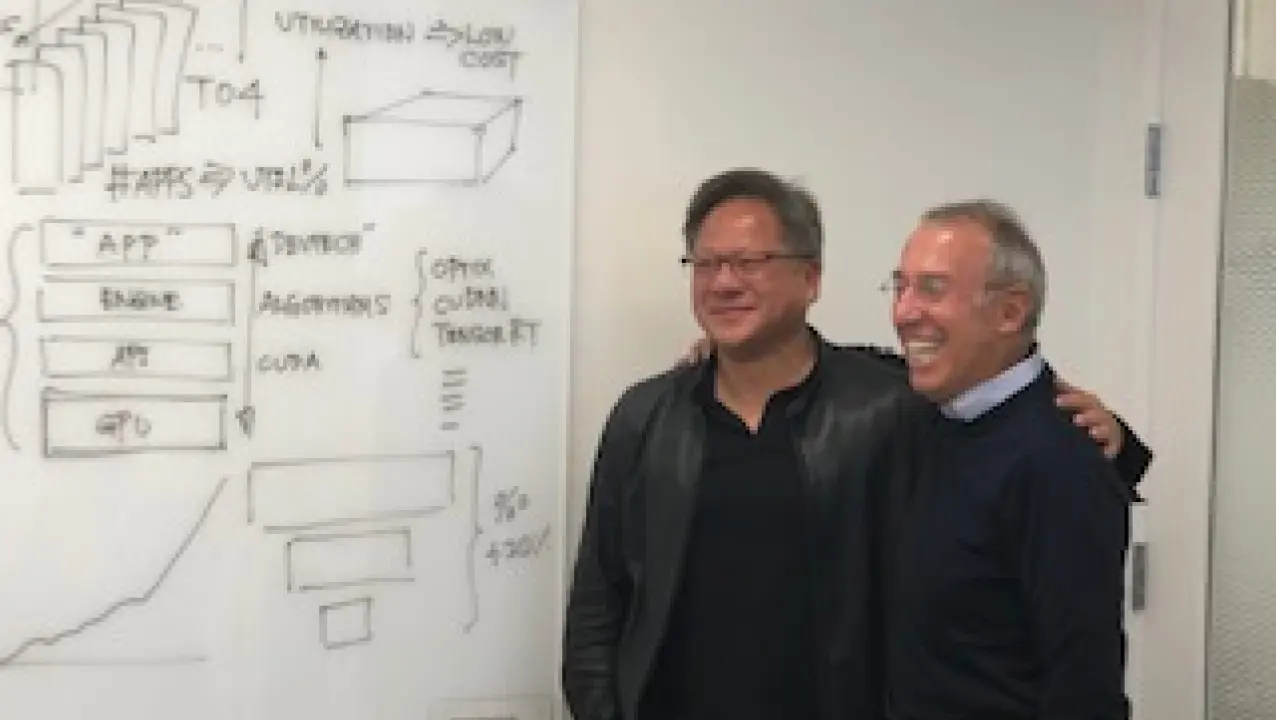
November 28, 2018
- We invested in Broadcom Inc. nearly three years ago after spending two hours with its CEO and founder Hock Tan. Broadcom has been a 5.6-bagger for the Fund. These returns resulted from explosive growth not multiple expansion.
- As you witnessed with the CEOs who spoke this morning, Baron research starts with people. We look for founders and management teams that are exceptional–but also who think long term and remain focused on building, not just managing. We also believe that sustained innovation is the competitive advantage of the future. In the past, a moat might have meant first-to-market, a distribution network, intellectual property, brands, or scale, and while these hold true, we think in today’s fast-moving world how fast a company can innovate, adapt, launch, and then scale new products is another critical competitive advantage. Baron investments like NVIDIA, Tesla, Inc., SpaceX, Spotify, and Shopify Inc. embody this mindset.
- We are not resting on our laurels; we are investing forward. The theme of the conference 10 years ago was “question everything.” That’s a key part of our research DNA and what we’re doing with AI. While I don’t have the time to list everything, a few of the key issues that we are questioning and studying include: scaling laws for model training, post training, and reasoning; the adoption, penetration, impact, and value (cost savings or monetization) of AI workflows and use cases for consumers and businesses alike; whether we can generate and deliver enough energy to power the compute data centers; and how AI investments will be financed, including how that will be different for the Magnificent Seven players like Alphabet, Amazon.com, Inc., Microsoft Corporation, and Tesla, who can fund their investments with internal cash flow versus the AI lab start-ups like OpenAI, xAI, and Anthropic, which need outside financing.
- In our view, the most important thing to study is not the race to Artificial General Intelligence or Artificial Super Intelligence but the utility and value of AI. We recently listened to a recent podcast with Andrei Karpathy, a prominent AI researcher and engineer, who worked at both OpenAI and Tesla, and who we have met in our work at Baron. One thing resonated with us (and we’re paraphrasing): Let’s focus on building useful things, not AI animals.
- AI is already delivering value and proving useful: AI software code development—near 100% adoption and productivity improvements of 30% to 50% or higher; AI has delivered significant cost savings in customer service; Tesla Robotaxis are driven by AI; Axon Enterprise, Inc. is using AI to prepare first drafts of police reports; Heartflow, Inc. is using AI to advance heart disease diagnostics and save lives; and this will be the first holiday season of AI commerce, where Shopify’s Catalog product will enable consumers to compete purchases with Shopify merchants without leaving AI chatbots. The massive opportunity ahead of us is scientific discovery—such as AI acting as the Rosetta Stone to help humans decipher the genetic language of cancer and other diseases.
- Technology paradigm shifts have multiple phases. The internet started on the desktop, then mobile, then the cloud. AI’s impact on the world will not be one S-curve, but a series of stacked S-curves. We have investments across different phases of AI and among many of these S-curves. While our most successful investments to date have been in the infrastructure layer of AI, we also have excellent investments across other layers of the AI stack, such as the application layer and physical AI.
Recent Activity
| Quarter End Market Cap ($B) | Net Amount Purchased ($M) | |||
|---|---|---|---|---|
| Broadcom Inc. | 1,641.0 | 5.2 | ||
| Amazon.com, Inc. | 2,467.5 | 4.0 | ||
| Meta Platforms, Inc. | 1,664.1 | 3.5 | ||
| Taiwan Semiconductor Manufacturing Company Limited | 1,576.1 | 3.4 | ||
| Axon Enterprise, Inc. | 44.8 | 3.4 | ||
We added to our Broadcom Inc. Position during the quarter. Broadcom is a leading semiconductor and enterprise software company, generating approximately 60% of revenue from semiconductors and 40% from software. The company remains strategically positioned at the intersection of high-performance AI compute and networking infrastructure, while also demonstrating disciplined execution in software. Broadcom continues to extend its leadership in networking silicon, from the cloud era into the AI era, and has established itself as the most reliable silicon partner for AI foundational model builders designing custom accelerator chips to train and inference frontier models. While Broadcom continues to execute with its key custom chip customer, Google, it is also ramping volume production with two additional customers (likely Meta and ByteDance), and has secured a fourth customer with orders worth $10 billion this year, and announced a 10 gigawatt deal with a notable fifth customer, OpenAI. Beyond AI, Broadcom is advancing VMware integration, while its non-AI semiconductor businesses appear to be bottoming and may gradually recover in the coming quarters.
While 2025 was a difficult year for Amazon.com, Inc., we believe that 2026 is poised to be better. We believe that Amazon Web Services (AWS) growth should accelerate to the mid-20s, based on contracts with Anthropic and other large enterprise customers. The company is also rolling out its new Tranium 3 chipset on AWS and has improved access to NVIDIA’s chip supply than it did in 2025. We also believe Amazon’s advertising business continues to drive greater incremental profitability for the company, and the rollout of robotics in their warehouses should help the company reduce fulfillment costs. In our view, the combination of faster AWS growth, and better profitability in the core retail segment, positions Amazon as an attractive investment.
We initiated a position in Meta Platforms, Inc. based on the belief that the narrative around the company will improve throughout 2026 and beyond. Even though Meta has delivered solid topline growth, beating Street expectations consistently, investor sentiment turned negative with the perception that Meta has fallen behind the other frontier AI model companies and is not earning sufficient returns on its large operating and capital investments. Trading at the lowest earnings multiple of the Magnificent Seven, we believe the risk/reward on Meta is attractive, and that investor sentiment will turn as the company is poised to launch two new large language models in the first half of 2026.
| Quarter End Market Cap or Market Cap When Sold ($B) | Net Amount Sold ($M) | |||
|---|---|---|---|---|
| Eternal Limited | 31.4 | 2.6 | ||
| Duolingo, Inc. | 11.9 | 2.3 | ||
| The Trade Desk | 23.3 | 2.0 | ||
| HPSP Co., Ltd. | 1.7 | 1.1 | ||
| Gartner, Inc. | 18.5 | 1.1 | ||
We decided to exit our long-term investment in The Trade Desk, predominantly due to mounting competitive pressures from Amazon's aggressive ad-tech push. While we do not believe Amazon has yet captured meaningful market share, our industry checks suggested that more agencies and media buyers are inclined to try and expand budgets with Amazon in 2026, which is leveraging exclusive Prime Video and Netflix inventory and offering significantly lower take rates. This situation was further exacerbated by substantial executive turnover. Given these challenges, combined with less consistency in recent results, we found the risk/reward balance to be unfavorable and chose to sell our position. Given the company's and CEO Jeff Green's prior track record, we continue to research and analyze the company and reserve the right to revisit an investment in The Trade Desk.
We decided to sell our position in Duolingo, Inc. this quarter before the company reported third quarter earnings. Our thesis in Duolingo was that given how large the opportunity was for global language learning, the company could continue to grow users at rates well north of 25% for years to come. We had previously considered decelerating user metrics to be a temporary result of a brief reduction in marketing spend following social media backlash related to the company's AI posts. However, early in the quarter, our research indicated that the user slowdown continued unabated. In its earnings report, management signaled growth concerns by acknowledging the trend through October and choosing to delay monetization levers, resulting in a meaningful deceleration in bookings growth. We believe this decision would not have been necessary if organic growth had remained more robust. Shares of Duolingo are down meaningfully since the report and our sale.
We exited out of our position in Gartner, Inc. to reallocate to higher conviction ideas, including our investments in optics-related names.
Finally, in preparation for a conversion to an actively managed ETF, we sold shares of Eternal Limited (India) and HPSP Co., Ltd. (Korea), as the Fund needed to re-apply for approval to trade in those geographies under the new structure.
Looking Ahead
Looking ahead, while 2025 was a disappointing year for us, we continue to uncover compelling long-term investments that meet our criteria. We remain focused on owning category-defining technology businesses that sit at the heart of durable, secular growth trends. Led by visionary, execution-driven management teams, these companies convert breakthrough innovation into expanding free cash flow. We believe this combination uniquely positions the Fund to compound our investors’ capital over the long term.
Sincerely,


Featured ETF
Learn more about Baron Technology ETF.