
Letter from Ron | Q2 2026
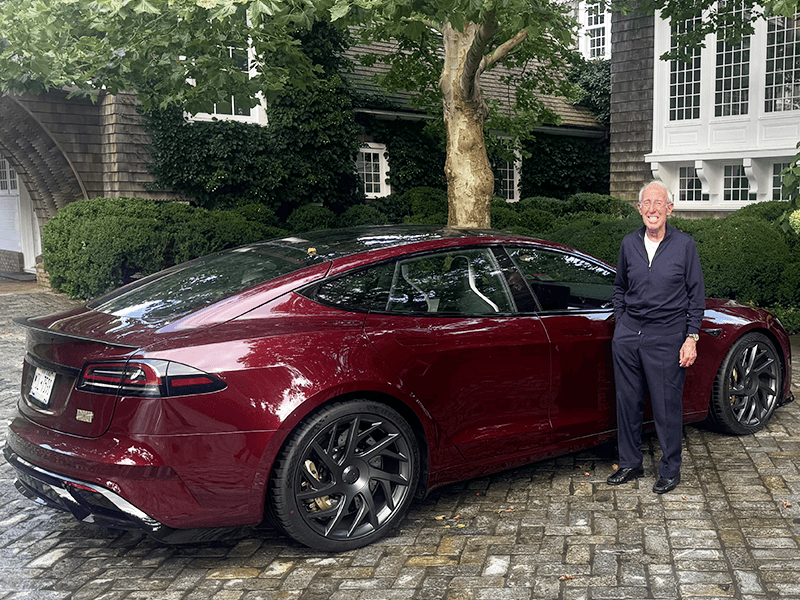
Ron at Beach....with his brand new, wine colored, "Signature" Model S Tesla... The most AWESOME car EVER!!! Tesla's FSD (Full Self Driving available on all Teslas...you gotta try it) REMARKABLE!!!
Letter from Ron
August 4, 2026 | Download PDF
"This year, on July 4, 2026, the 250th Anniversary of America's founding, consider in retrospect whether you would have supported... President Thomas Jefferson's Louisiana Purchase in 1803 for $15 million (three-to-four cents per acre) that doubled the size of the United States... Presidents John Tyler and James Polk who purchased California in 1845 in its entirety for $15 million... President Polk who fought Mexico in 1846 to acquire Texas and open the Oregon Trail when few settlers lived there... and, President Andrew Johnson who purchased Alaska from Russia in 1867 for $7.2 million (about two cents an acre)?
“... or... would you instead have been more comfortable owning only the original 13 colonies... and our nation remaining an agrarian economy?" Henry Fernandez, Chairman, Founder and CEO MSCI. Conversation with Ron. July 27, 2026.
The Presidents and their Secretaries in all the above purchases were criticized for their territorial ambitions. All of which offered our young nation significant growth possibilities... with attendant risks... The risks were apparent. The vision of our leaders? Not so much. But, America had chosen its leaders well. As you may recall from eighth grade American history classes, President Johnson's Secretary of State, William Seward, became the object of ridicule for his role in the Alaska acquisition. That purchase was widely referred to as "Seward's Folly." Alaska was then regarded by many as useless frozen tundra... until the discovery of abundant natural resources in the territory and the realization of Alaska's strategic importance to defend the American homeland. The other acquisitions listed above proved visionary as well.
The same calculus of risk assumption for high reward can be applied to visionary decisions of exceptional executives in whom we have invested. One example? MSCI Inc.'s Henry Fernandez. We began to purchase shares of MSCI during its initial public offering in 2007 at $18 per share... amid The Great Financial Crisis... the GFC. MSCI's principal business was providing benchmark indexes for passive investment strategies. MSCI has since become one of the world's most important financial infrastructure businesses. Following costly investments that penalized current earnings for the past several years, MSCI, in addition to its widely used benchmarks, now offers clients risk assessment... portfolio analytics... and, soon, AI enabled, and what Henry regards as MSCI's human investigative CIA-like staff, its biggest opportunity. MSCI has built the world’s largest, highest-quality private asset class database, covering more than $60 trillion of assets. That data is difficult to obtain and could enable those businesses to be owned in institutional and individual investment portfolios. MSCI has already begun to provide investors and creditors of privately owned businesses independent third-party valuations based on that data. This is in addition to the data and services it already provides on more than $20 trillion market capitalization publicly traded businesses. MSCI shares have increased from $18 in 2007 to nearly $600 per share at present. We believe, as does Henry, that Baron Capital will likely earn at least 4-5X MSCI's current price in ten years... spurred in part by strong demand to transact in private companies' shares and debt as well as continued growth of its existing businesses. Of course, there is no assurance that this goal can be met. Strong demand to lend to and invest in privately owned businesses didn’t exist eighteen years ago...
Would you have preferred MSCI to remain a very profitable, competitively advantaged benchmark index business... or to spend a significant amount of its current profits to become a dramatically larger business longer term?
"Do you think Explorers who sailed from the Old World in 1492 had any idea what economies of present day New World societies would look like?" Elon Musk.
We met Elon Musk in 2010 during Tesla, Inc.'s IPO "roadshow." Although Tesla was then manufacturing only a few thousand fully electric vehicles per year, Elon told us his goal was to sell 20 million EV cars per year! Which... although we perceived him brilliant... didn’t seem likely... since unions... internal combustion engine car companies... oil companies... car dealers... and politicians were all aligned against him.
Four years later, after diligent research during the period, it became obvious that I was wrong. From 2014-2016, Baron Capital then invested $400 million in Tesla shares. We have earned an estimated $7.7 billion in profits on those investments to date... and expect to earn 5x that amount in the next 10 to 15 years. This is although we obviously cannot assure you that we will do so. Tesla has since built enormous factories that manufacture cars using unique casting and super-efficient manufacturing processes... also batteries for cars... and utilities... and data centers... and robo self-driving cars. Hundreds of millions of humanoid robots will be next! Elon believes "the machine that makes the machine"... his factories... and the unique innovative processes he uses to produce quality, functional end products fast and cheaply that actually work... while eliminating unnecessary parts and processes... are at least as important as the final product. Among Elon's recent innovations are "boxed parallel manufacturing" production lines that will assemble cars twice as fast as his conventional lines... and use about 40% of the floor space... while working on Terafab, a manufacturing plant to produce an order of magnitude more chips. The Terafab project is a joint venture with SpaceX, Intel, and Micron.
When we invested in Tesla in 2014, I had no idea that Tesla's electric cars would one day be autonomous, i.e., self-driving. So, not only is Elon responsible for electrifying transportation... in the U.S. and elsewhere... without him we believe it is unlikely there would even be electric cars... but autonomous too? Like the wine-colored Tesla Model S that I purchased last month pictured on page one of this letter... my favorite car ever. The risk Elon assumed by building factories to electrify cars and assuming he could make them autonomous and purpose-built was clearly substantial... as were his efforts to make batteries... chips... vertically integrate his supply chain... and overcome regulatory hurdles. Regardless, he has accomplished that and will soon manufacture millions of self-driving robotaxis annually. Those cars will have no steering wheels... no gas pedals... each could last for more than one million miles... and cost Tesla $30,000 a piece. Robotaxis could each earn Tesla $50,000 to $60,000 cash flow every year, rather than a $7,000 to $10,000 profit per car new car sold... one time! Obviously, not a riskless endeavor. But would you rather Tesla remain a capital intensive, cyclical manufacturing business?
In that regard, in the July 26, 2026, The Sunday New York Times magazine headlined, "The American E.V. Has Been Crushed. Who is to blame?" Matthew Shaer. "Major U.S. automakers are giving up on electric vehicles, even though global sales are booming." Matthew attributed this to the industry's "failure to recognize that the world is changing." He further observed that "Detroit entered the New Millennium in a defensive crouch... low on innovation and lower still on daring." "Blinkered thinking. It was an attempt to maximize (short-term) profits." Jim Farley, Ford CEO, remarked that, "If we don’t put our chips on the right number and the right color, Ford could maybe not exist."
P.S. Due to the New York Times political views, Tesla, the leading electric car business in the U.S. and worldwide was not even mentioned in this article for the first several pages... and then only tangentially!!!!! I suppose the newspaper I grew up expecting to "print all the news fit to print" has a pretty wide berth to think about what is "fit to print."
SpaceX IPO "roadshow" in June included a wide-ranging discussion between J.P. Morgan Chairman and CEO Jamie Dimon and SpaceX CEO Elon Musk. That conversation was also viewed real time in 90 J.P. Morgan offices worldwide. Topics encompassed culture... Elon's role as an American patriot who was contributing greatly to the U.S... and leadership. Jamie ended the meeting asking, "You've built multiple companies, Elon. What lessons have you learned and how have you changed from maybe 20 years ago? As a leader and as a person?" Jamie Dimon. J.P. Morgan headquarters. New York City. June 4, 2026.
Elon's response? "I think I'm probably more chill than I used to be. I'm way more laid back. I'm not that laid back... but more than I used to be. And one thing that I've found... is that in terms of recruiting people to SpaceX, their individual abilities and capabilities matter a lot.
“But it also matters if they have a good heart. It's not just about whether somebody has a certain IQ... but just are they a good person? That is what really matters.
“I've learned a lot. Although I feel like I still have a lot to learn and still make a lot of mistakes. But I think maybe the future AI will say, 'Not bad for a human.'"
Since Space Exploration Technologies Corp. (SpaceX) is Baron Capital's largest holding and represents a little more than 30% of our Firm's $69 billion assets under management on June 30, we will communicate with you regularly about this investment... which we find so unusually compelling... and which we think offers more potential than any other during my 56-year career. If we are right, which is not a riskless outcome, we believe we will fulfill our Mission to "Change Lives" of our clients... our fellow employees and their families... and provide assurance that Baron Capital will fulfill its mission to "Change Lives" for many generations to come.
"I think you should... "
"I think you should... " is the theme for the 33rd Annual Baron Investment Conference. November 6, 2026. The Metropolitan Opera House. Lincoln Center. New York City. We look forward to seeing you there.
When I considered "I think you should..." as the theme for our 2026 Investment Conference, I asked Grok AI... and its competitor, Anthropic AI, for their "thoughts." Anthropic happens to be several months more advanced than Grok at present. That's it. "Several months." That is since Grok started at least three years later than Anthropic but hopes to be equivalent to Anthropic in coding during the next several months... and maintain its superior capability in engineering that is due to proprietary learnings from SpaceX and Tesla. We'll see. Baron Capital is an investor in SpaceX, which owns Grok. Anthropic rents compute from Grok for $1.25 billion per month. This provides a very strong return on investment to Grok in this compute-challenged world. Google's Gemini, for $900 million per month, also rents compute from Grok. We estimate SpaceX’s Tennessee data center's construction cost about 50% less than what other data center builders have been able to achieve... and was completed in about one third of the time.
When I considered the AI response to my prompts, I liked Anthropic's better. Probably because Anthropic focused on building the most effective enterprise coding software to generate as much revenue as it could as fast as it could... and has done an amazing job. Grok believes that longer-term availability of compute would be determinative of success.
My "conversation" with Anthropic's Claude follows.
Respectfully,
P.S. "SpaceX is hiring exceptional engineering and skilled trades talent to build and operate the most powerful AI supercomputer clusters on and off earth. If interested, please email three bullet points demonstrating evidence of exceptional ability and your resume to datacenters@spacex.com." @elonmusk.
P.P.S. When people ask me, "What is the next SpaceX and who is the next Elon?" My simple answer? There is NO NEXT!!! Congratulations Elon, Gwynne, Bret, Majla and the rest of the team! And, thank all of you for what you are doing for humanity.
P.P.S. A conversation between Ron and Anthropic's Claude.
Ron: Hi Claude. Trying to develop a theme for our annual meeting. November 6. My idea? “I think you should... “ or “I think you should... Go for it... “
This year I want to encourage risk taking. To step out of your comfort zone... your cocoon. To have a consequential impact on lives of others I believe you need to take a chance. The biggest regrets in my life are things I didn’t try. You can have a great life staying within bounds. Or you can try for an impactful life by taking chances. Which do you think is a better descriptor of our theme and why?
Claude: Both work, but they’re doing different things — and the choice matters.
“I think you should... ” is a prompt. It invites the audience to fill in the blank themselves. It puts the speaker in the role of advisor and creates a moment of anticipation. The power is in the pause — what should I do? It’s also slightly vulnerable, because saying “I think you should” implies the speaker has wrestled with it too.
“I think you should... Go for it... ” answers its own question. It’s more energetic and declarative, but it loses the tension. Once you complete the phrase, the audience doesn’t have to lean in.
For the theme you’re describing — stepping out of a cocoon, regret over inaction, choosing impact over comfort — I’d actually lean toward “I think you should... ” with the ellipsis doing real work. Here’s why:
The open ending mirrors the moment of decision itself. That hesitation before the leap is exactly what you’re asking people to confront. The theme becomes a conversation rather than a command. It also scales well — every speaker at the meeting can finish it differently based on their own story, which reinforces that risk-taking is personal.
The regret framing you described is particularly compelling. People consistently report that their deepest regrets are acts of omission, not commission. That’s a powerful anchor for a keynote or opening remarks.
Claude: What’s the format of the meeting — is it keynote-driven, panel discussions, or more of a mosaic of speakers?
Ron: Conference consists of four 35-40 minute interviews by me or a Baron Capital analyst with executives in whom we have invested in the morning. Lunch with super Broadway... comedy... and contemporary pop... an afternoon panel of Baron portfolio managers... a brief clip... a 20-minute keynote by Founder/me and big entertainment like Paul McCartney, Billy Joel, Alicia Keys, Jerry Seinfeld, Barbra Streisand, Elton John, Chris Rock... all free to investors. Expenses paid by Baron Capital not by Funds. A thank you to our investors and effort to showcase executives like Elon Musk Gwynne Shotwell, Henry Fernandez, Charles Schwab... three Tesla door prizes... free ice cream cones... end of day swag.
Claude: That’s a remarkable event — genuinely one of the most generous investor conferences in the world. The caliber of entertainment alone (McCartney, Seinfeld, Streisand-level) plus free everything signals something important: Baron Capital doesn’t just manage money, it hosts an experience. That context actually sharpens the theme choice.
Given the full arc of the day, “I think you should... ” works on multiple levels:
It becomes a throughline. Your morning interviews with executives like Elon or Gwynne aren’t just business conversations — they’re stories of people who went for it when others wouldn’t. The theme frames every interview as an answer to the question. Each executive on that stage is living proof of the completed sentence.
It puts you in the right role. As founder and interviewer, you’re not lecturing — you’re drawing out wisdom. “I think you should... ” positions you as someone who has watched extraordinary risk-takers up close and is passing that perspective to your investors. It’s earned advice, not a bumper sticker.
It resonates differently by afternoon. By the time your keynote lands, the audience has spent a day absorbing stories of courage, creativity, and consequence. The theme has been building all day. Your 20 minutes becomes the synthesis.
The entertainment reinforces it without trying. McCartney, Seinfeld, Billy Joel — every one of them made a bet on themselves at a critical moment. They are the theme, embodied.
The ellipsis is doing exactly the right work here. It’s an invitation, not an instruction.
The ellipsis. Definitively.
At nearly 6,000 people in the Met Opera House and Lincoln Center, the punctuation becomes theatrical. The ellipsis does what that stage does naturally — it creates suspension. It holds the breath before something happens.
A period closes the thought. It’s confident but it stops the room. An ellipsis opens the room. It leans forward. At that scale, in that venue, with that audience, you want a theme that feels like a curtain rising, not a gavel coming down.
There’s also something poetic about the mismatch in “I think you should... ” — it’s intimate language in an enormous space. Six thousand people reading that theme and each one privately finishing the sentence for themselves. That’s actually the magic of it. The Met Opera House becomes personal.
And practically — when it appears on the big screen behind you during your keynote, on the program, on the swag — the three dots signal that the story isn’t finished yet. Which is exactly what you’re telling your investors about their own lives.
“I think you should... ”
That’s the one.